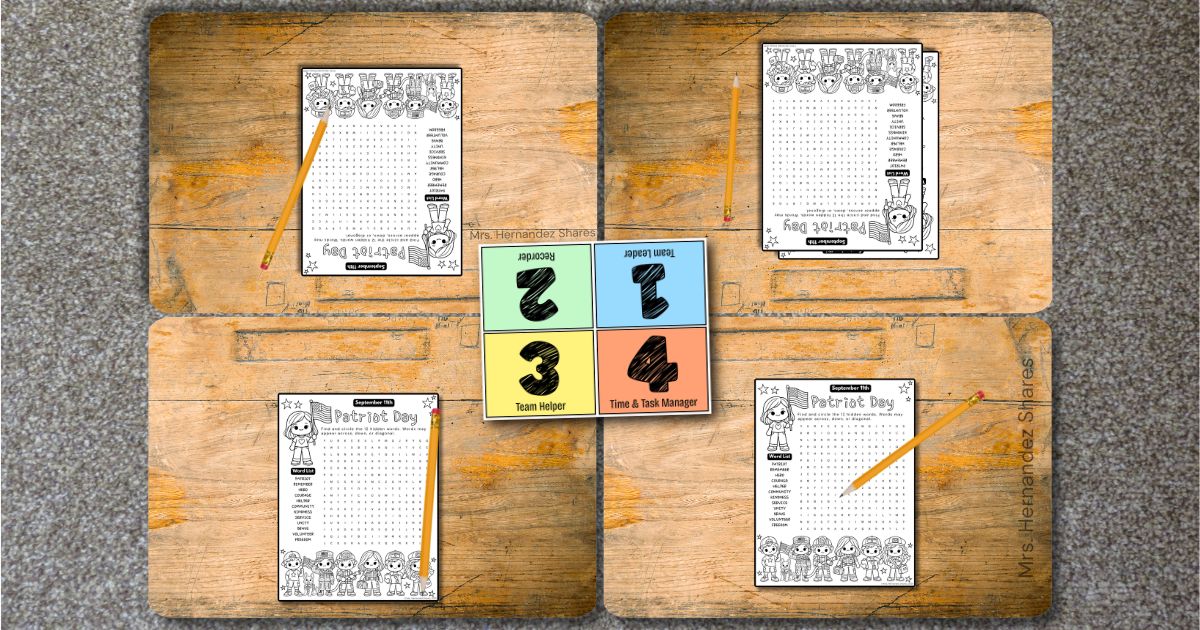
Okay so. Real talk for a second. You know that moment when you say “find a partner” and what should take fifteen seconds somehow eats three full minutes of your life? Chairs scraping, someone’s feelings getting hurt because their bestie already partnered up with someone else, and at least one kid just… standing there. Just vibing. Not partnered with anyone. Somehow invisible.

And it’s not just partners, is it? It’s the SAME four questions, every single time, no matter what the activity is:
- Who’s writing this down?
- Who’s sharing with the class?
- Why is Timmy just… drawing on his arm right now while his group does all the work?
- “Wait, what am I supposed to do?” (asked approximately 45 seconds after you finished giving directions)
If any of that made you nod so hard you pulled something, good news — I’ve got a classroom management fix that’s honestly kind of embarrassingly simple, and it’s made a real difference in how smoothly group work runs in my room. Ready? Here it is:
Give every kid a number.
That’s it. That’s the hack. I told you it was simple.
The Basic System: Numbers 1–4 (a.k.a. My Favorite Kind of Magic)
Here’s how it works: at the start of the year, every student at a table or team gets a number, usually 1 through 4. That’s it. That number becomes a permanent little tool you get to use ALL YEAR, in every subject, for basically any task that involves more than one human being working together.
The beauty of it is that once numbers are assigned, you never have to re-explain anything. You just say a number and boom — everyone knows exactly what to do. No re-deciding, no re-negotiating, no eleven-minute chair-shuffling situation.

This little system quietly does a lot of heavy lifting for classroom management. It shaves off transition time, gives every kid a clear job in group work, and builds student accountability, because — plot twist — nobody gets to disappear into the background when you can call on literally any number at any moment. Sneaky? A little. Effective? Extremely.
Examples You Can Steal and Use Tomorrow (No Prep Required, You’re Welcome)
Once numbers are assigned, here’s what this sounds like in real life:
- “1s talk to 2s. 3s talk to 4s.” — instant turn and talk partners. No rearranging, no drama, no eleven minutes.
- “Number 3, share first.” — RIP to the awkward silence where nobody wants to volunteer.
- “Discuss as a group. I may call any number to explain.” — this one honestly does more for accountability than almost anything else I use, because suddenly every single kid has to actually be ready to talk. Shocking how well that works.
- “Number 4, please turn in your team’s paper.” — and just like that, papers stop mysteriously vanishing into the group work void.
These numbers also play really nicely with strategies you’re probably already doing — Turn and Talk, Round Robin, Pair-Square, Numbered Heads Together. You’re not adding a whole new thing to your plate (I would never do that to you, we have enough on our plates already). You’re just giving the stuff you already do a faster, way more consistent engine to run on.
Turning Numbers Into Cooperative Learning Jobs
For the bigger stuff — longer discussions, projects, anything that needs more structure than a 90-second turn and talk — each number can also line up with an actual job. This is where table group jobs come in, and honestly this is the part that made group work feel less like herding cats:
1 — Team Leader
Gets the group started, rereads directions when someone inevitably asks “wait what are we doing,” and keeps everyone included. May share the group’s thinking with the class, but does NOT get to do all the talking (we’ve all met that kid).
2 — Recorder
Listens to the team’s ideas and writes down the group’s actual response — not just their own personal opinion smuggled in as “the group’s answer.” Sneaky recorders, we see you.
3 — Team Helper
Notices when someone’s stuck, encourages teammates, asks clarifying questions. Basically the emotional support human of the group.
4 — Time & Task Manager
Watches the clock, keeps everyone on task, manages the materials, and turns in the finished work. The unsung hero of “we actually finished on time.”

The jobs are intentionally broad on purpose. They’re built to flex, whether your kids are doing a reading response, a math problem set, a science lab, or a two-week project. You’re not reinventing new roles for every single subject, which, again — we have enough on our plates.
Why Roles Are NOT a Permission Slip to Check Out
Here’s the part I really want to hammer home, because it’s easy to miss: having a job is not the same as having a hall pass out of thinking.
The Recorder holds the pencil, but the whole group owns the thinking. The Team Leader guides the conversation, but doesn’t get to make every decision solo (sorry, bossy 1s, I see you too). The Time & Task Manager keeps things moving without turning into the group’s tiny, clipboard-wielding boss.
No matter the job, the expectation stays exactly the same for every single kid: think, talk, help, learn. The jobs organize how the group runs — they are absolutely not an excuse for anybody to quietly float through the assignment doing nothing while their group does the work. This is worth saying out loud to your class more than once (I mean that — more than once. Repetition is a love language in elementary school).
How I Would Introduce This System to Students
Rolling this out doesn’t need to be a whole production. Here’s a simple, no-stress first-week plan:
Day 1 — Just assign numbers. Skip the jobs entirely for now. Let kids get comfortable knowing their number using something low-stakes, like a 60-second turn and talk about their weekend or their favorite snack (never underestimate the power of a snack-based icebreaker).
Day 2 — Practice with numbers, still no jobs. Try “1s talk to 2s” and “I may call any number to share” during an actual lesson so the accountability piece starts feeling normal early on.
Day 3 — Introduce the four jobs. One easy way to do this is walking through each job out loud using simple “I can… / I should not…” language, so kids understand the boundaries clearly (this is also a great excuse to make a slightly dramatic anchor chart, if that’s your thing — no judgment, it’s my thing too).
Day 4 — Practice the jobs on something low-stakes. Keep the task short and simple so the focus stays on understanding the roles, not the content.
Day 5 — Use it for real. Fold it into an actual reading, math, or science lesson, jobs and all. By this point, most kids have their number and job memorized, and you get to stop re-teaching it forever. (Forever is a strong word. Most of the year. Let’s be realistic.)
Practical Tips: Rotating Roles, Small Groups, and Everyday Chaos Management
A few things that keep this running smoothly long-term, learned through mild trial and error:
- Rotate roles regularly. Rotating numbers or jobs every week or two means everyone gets practice at every role eventually, instead of one kid becoming a “professional Recorder” for life because it’s comfortable.
- Groups with fewer than four students still totally work. Table only has three kids? Skip a number, or have one student pull double duty (Team Helper also handles time, for example). This system flexes — it’s not a strict four-or-bust situation.
- You don’t need the jobs every single time. Plenty of days, you just need quick partners for a turn and talk — that’s when the plain numbers (no job assigned) come in clutch. Save the full job structure for the bigger stuff, like projects or longer discussions, where the extra structure actually earns its keep.
Using This System Across Every Subject (Because Repeating Yourself Five Times a Day Is Exhausting)
The best part of a numbered system is that it’s not stuck to one type of lesson. A few places it shows up across the day:
- ELA: Turn and talk during a read-aloud, discussing evidence for a claim, partner reading check-ins.
- Math: Numbered Heads Together for problem-solving, one student recording the strategy while another keeps time.
- Science: Lab groups where the Recorder tracks data and the Time & Task Manager keeps an eye on materials (so nothing “accidentally” ends up in someone’s desk).
- Social studies: Structured discussion of a primary source, with the Team Helper making sure everyone gets a turn before moving on.
- Centers and rotations: Quick accountability check-ins with numbers, no reassigning needed every time centers rotate.
- Projects: Full, longer-term use of all four jobs, since a multi-day project genuinely benefits from clear, consistent responsibilities.
- General class discussion: “I may call any number” keeps every single kid ready to contribute, even in a whole-class conversation.

Preparing the Materials for Long-Term Classroom Use
However you decide to display the numbers, a little bit of prep now saves you from redoing this in October, February, and again in May (we’ve all been there):
- Print the mats — number-only for everyday use, or number + job for more structured group work.
- Cut them apart so each number or job can sit individually at each student’s spot.
- Laminate them, because these things will get touched, dropped, and possibly loved a little too aggressively by small hands. Laminating also lets you print number-only on one side and number + job on the other, giving you a reversible mat (which honestly feels like a life hack all on its own).
- Store them somewhere easy to grab and reset — whether that’s permanently at each table, or in a labeled container you pull out at the start of the year or whenever you rotate roles.

If designing and printing your own set from scratch is not how you want to spend a planning period (relatable, deeply relatable), this is exactly why I made Table Group Number Mats & Cooperative Learning Jobs. It’s got number-only mats, number + job mats, and a teacher guide plus a student-facing guide — so the whole system is ready to print, laminate, and use without you having to design a single thing.

Give It a Try
You don’t have to overhaul your whole classroom management system to feel a difference — just start with the numbers. Once your kids know who’s a 1, a 2, a 3, and a 4, so much of the guesswork just… disappears from partner work, group discussions, and cooperative tasks in general.
And if you’d rather grab the whole thing already designed and ready to go, you can find Table Group Number Mats & Cooperative Learning Jobs in my TPT store.
Tools I Used
Quick heads-up before you scroll: a few of these are Amazon affiliate links, which means if you click through and grab something, I earn a small commission at no cost to you (as an Amazon Associate, I earn from qualifying purchases). These are genuinely the exact stuff sitting on my own classroom shelf — affiliate link or not, I’d recommend them to you at a staff meeting.

Scotch laminator I purchased in 2022 and still works amazingly!

Laminating sheets, which I usually buy 200 count packs at a time… the last time I purchased a box as of publishing this blog post was May 2026.

Swingline Paper Cutter I actually keep at home and have since February 2024. My older one was gifted to me when I started teaching and lives at school :)
Leave a Reply